
Have you ever knocked on your neighbor’s door just to say hello?
Imagine walking through your block on a crisp evening, clipboard in hand, gently knocking on a door and saying, “Hi — my name is Maria, and we’re hoping to talk with all our neighbors about ways we can make our neighborhood safer. Do you have a few minutes to talk?” That moment of face-to-face contact might seem ordinary. But in neighborhoods that have been affected by crime, that simple gesture can be revolutionary. It’s a signal that other people care about the state of the community and want to be a part of the change.
This is why neighborhood canvassing is so powerful. It connects neighbors, provides hope, and promotes peace. In this blog, we’ll explain how personal outreach through canvassing can strengthen safety and community and how to get involved in your community.
What is Neighborhood Canvassing?
Neighborhood canvassing is as simple as you think it is – a coordinated effort going door-to-door or engaging people in public spaces like sidewalks, parks and common areas to share information, listen to residents’ concerns, and build trust. It relies on authentic human connection, making it a more personal and effective way to share information compared to posting flyers or connecting over the phone or internet. The canvasser’s role is to listen, learn, and connect.
Neighborhood canvassing efforts are often part of larger movements to:
- Promote peace through violence prevention: building relationships so residents feel empowered to intervene, learn about resources, and reduce social isolation
- Increase civic engagement: encouraging participation in public life, from local meetings to elections
- Create community connections: stitching together a social fabric so people don’t feel isolated or powerless in their blocks
When done well, canvassing turns a collection of homes into a true community where people who know each other, trust each other, and cooperate.
History of Canvassing
Neighborhood canvassing isn’t new. Its roots trace back through social movements and community-based activism.
Door-knocking has long been a staple: grassroots campaigns, union drives, and civil rights workers used it as a way to mobilize, listen to people’s needs, and shift power.
Over time, that model adapted: today, violence-prevention nonprofits use canvassing not just to persuade but to build relationships, trust, and deliver services.
Major Examples of Effective Canvassing Efforts
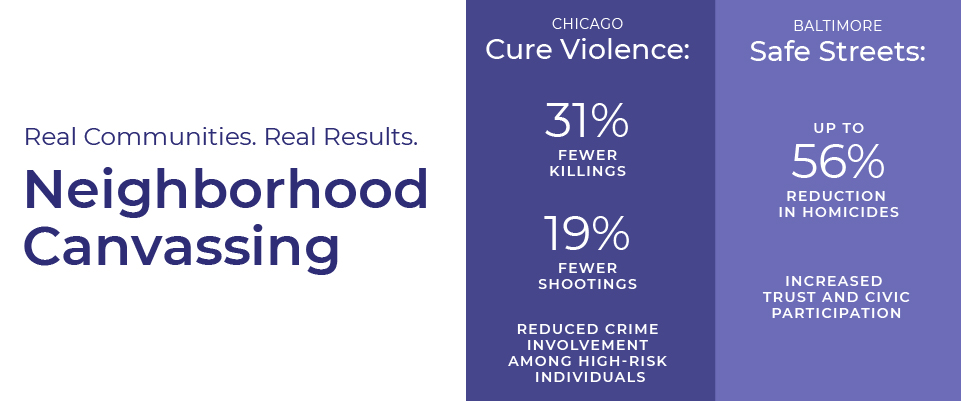
Cure Violence (Chicago, 2000-Present)
This program treats violence like a contagious disease: it sees violent incidents as transmissions that can be interrupted, high-risk individuals as vectors, and social norms as influencing spread. Among other tactics, Cure Violence mobilizes communities through neighborhood canvassing to create authentic connections, support the families of victims and spread information to make communities safer.
In 2015, the University of Chicago released a quantitative and a qualitative evaluation of the program covering two Chicago neighborhoods. In the neighborhoods, they saw:
- 31% greater decrease in killings
- 1% greater decrease in total violent crimes (including domestic violence)
- 19% greater decrease in shootings
- High-risk participants reported decreased involvement in crime and violence
Safe Streets (Baltimore, 2007–Present)
Inspired by the Cure Violence community violence intervention (CVI) model, Safe Streets is a program run by the city of Baltimore which employs outreach professionals to mediate brewing conflicts that could result in gun violence. Safe Streets workers focus on community engagement initiatives, community outreach, public education, conflict mediation, and violence interruption within a specific geographic area.
In a 2023 report from Johns Hopkins University estimating the effects of Safe Streets Baltimore on gun violence, researchers found 56% reductions in homicides in some Safe Streets neighborhoods compared to control areas. Beyond crime reduction, the program improved trust between residents and local agencies and increased participation in block meetings and youth programs.
How to Organize a Neighborhood Canvass (Step-by-Step)
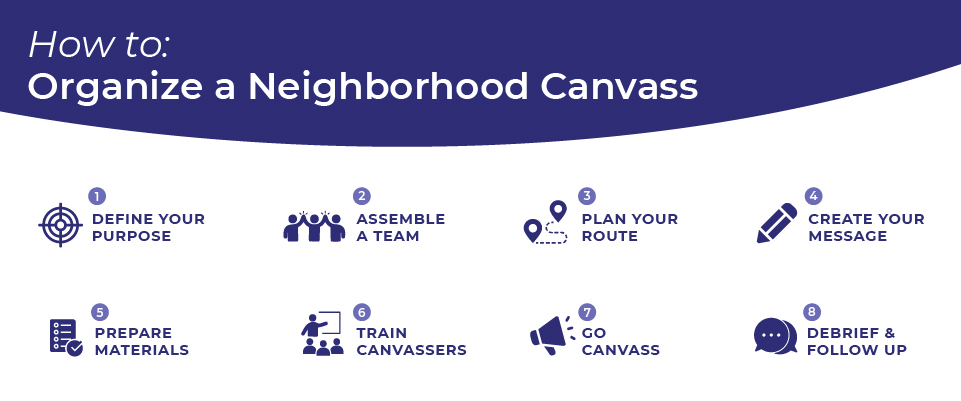
Define Your Purpose
Are you looking to prevent further violent crime activity in a specific neighborhood? Raise awareness for community safety initiatives? Increase attendance at neighborhood association meetings? By defining your goals, your canvassing effort will be focused and outcome driven.
Assemble a Team
Recruit volunteers or neighbors who are familiar with the area or trusted in the community. Aim for diversity in age, background, and identity so your outreach feels inclusive. There are always people thinking, “How do I find volunteer opportunities near me?” Neighborhood canvassing events are the perfect opportunity to engage your local community.
Plan Your Route
Use maps or canvassing software to segment neighborhood blocks. Prioritize:
- High-need blocks (crime hotspots, vacant homes, less-connected blocks)
- A manageable number of doors per team (30–50 for a few hours)
- Logical walking routes (looping streets, minimal backtracking)
Create Your Message
Keep your message clear and obvious, relatable, and conversational. Take this time to define what you want to share with neighbors and what you want to learn from them.
Prepare Materials
- Flyers or handouts with resource lists, meeting information and contact info
- Conversation guides for volunteers (possible questions, conversation prompts)
- Clipboards and forms for noting residents’ feedback (names, issues, offers to volunteer)
Train Canvassers
Work with canvassing volunteers to make the neighborhood experience consistent. Volunteers should be:
- Respectful for neighborhood issues
- Aware of their surroundings with set schedules and regular check-ins
- Comfortable with asking questions and listening
- Pro Tip: Practice with your volunteers so they get a chance to get comfortable with the process of knocking on doors and having these conversations with neighbors.
Go Canvass
Knock on doors, introduce yourself, ask to talk, share information, record concerns, invite people to participate in the next steps (meetup, block check-in, etc.).
Debrief and Follow Up
After the canvass, be sure to gather as a team to share what people said, adjust messaging and routes for next time, plan follow up with residents who expressed concerns or interest, and maintain momentum by planning future events and outreach opportunities. Ask each other questions like: “What did we hear/observe? What did we learn? Where should we try next?”
What You’ll Need
- Easily identifiable organization-branded clothing
- Printed flyers or handouts
- Clipboards, pens, and notes for feedback
- Comfortable walking shoes and weather-appropriate clothing
- Maps or canvassing software apps
- Water, snacks, and a positive attitude
Get Started Yourself
If you’re reading this, you’ve already taken a mental step toward building community engagement initiatives. Now, it’s time to take a physical step. Here’s how you can get involved with KC Common Good’s canvassing efforts:
- Signup for the KC Common Good newsletter to hear about upcoming events you can be a part of
- Stay up to date with events hosted by KC 360 partners at the community events calendar
- Attend a KC 360 meeting to get connected with like-minded individuals and organizations
At its core, neighborhood canvassing is about people. It’s about interrupting isolation, rebuilding trust, and reviving the idea that we are responsible to and for one another. The method is simple: knock, listen, share, connect. The impact, over time, can ripple outward, bringing better awareness, safer streets, and stronger community.
So go ahead: lace up your shoes, gather your neighbors, and knock on that first door. Small conversations can spark big change.
If you are interested in joining a local Kansas City neighborhood canvassing effort, we are happy to have your help! KC Common Good and KC 360 regularly canvass the neighborhoods we support.
Connect with us today to see how you can volunteer your time in a neighborhood canvass.